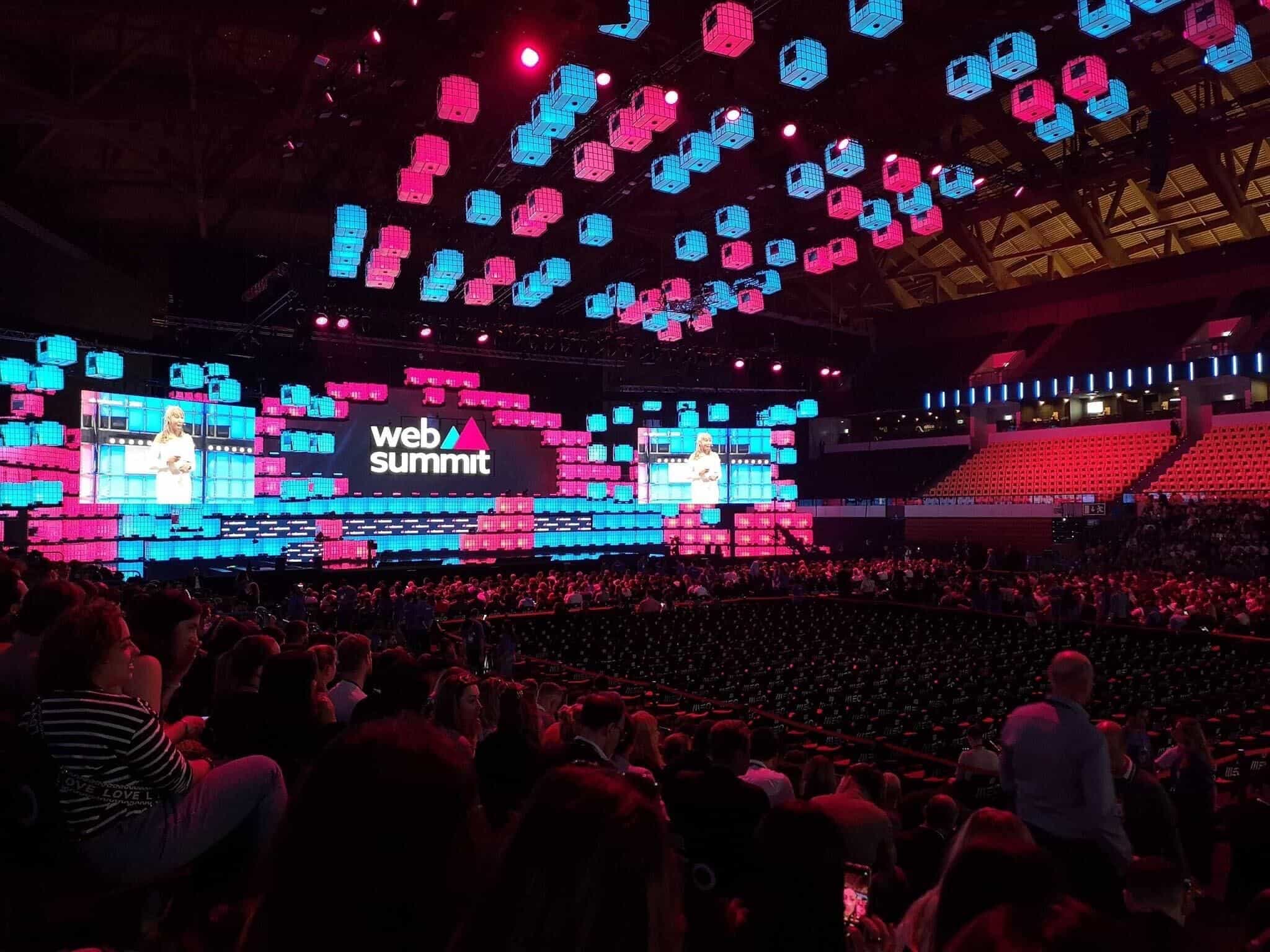
Last November, our web developer, Martin Choquette Scott, flew to Lisbon, Portugal, to take part in the Web Summit, the true mecca of the digital world that brings together over 70,000 participants from all corners of the globe. This event, renowned as the world’s largest in the technology sector, was the stage for captivating discussions on artificial intelligence (AI), the Internet of Things, and cloud computing—fueled by the presence of more than 2,600 innovative startups.
Today, we’re sharing some of the insights that have stayed with Martin since his return home.
Legitimate concerns, despite remarkable advances
Opinions about AI’s impact on our daily lives and the growing role these technologies will play in the years ahead poured in from every direction. While many remain optimistic about its benefits, it’s important to highlight some caveats regarding ethical considerations, regulatory frameworks, and AI governance that were brought to light during numerous presentations at the Web Summit.
One of the event’s key moments was a talk by Meredith Whittaker, former Google employee and president of the Signal Foundation, who expressed her apprehensions about the lack of democratization in AI.
“I think my fears concern less the technology itself than the fact that it is being developed and controlled by a small number of large companies whose interests are, of course, corporate interests—profit, growth, and shareholder satisfaction—not necessarily the social good,” Whittaker said. She also co-founded the AI Now Institute.
“The AI they sell, license, create, and deploy requires enormous quantities of data, enormous computing power, and effectively strengthens and extends the surveillance-based business model that lies at the heart of so many global concerns about irresponsible technology.”
On the other hand, artificial intelligence is driving promising innovations, particularly in healthcare. For example, MediRapp AG is transforming ultrasound diagnostics by automating everything from data collection to diagnosis and report generation. With AI, MediRapp makes the entire process faster, more accurate, and more efficient, significantly improving patient care. It’s an excellent demonstration of how AI can handle nearly unlimited amounts of data, deliver enhanced analysis, and support better decision-making.
The rise of the Internet of Things
Whether it’s a watch, a household appliance, or a car, connected objects are—and will be—ever more present in our daily lives. AI has sparked a profound transformation of the Internet of Things by accelerating the number of applications for these connected devices. The fact that your refrigerator could soon prepare your shopping list and send it to the store so it’s ready for pick-up on Saturday morning is impressive in itself.
However, one of the most astonishing innovations points to the future of linguistic interaction. Unbabel, an AI company offering translation services, unveiled a new project called Unbabel Halo: a wearable AI device with biological sensors to help individuals communicate through thought. During a demonstration, Vasco Pedro, co-founder and CEO of Unbabel, showed how the device works in real time by taking questions from the audience and responding via WhatsApp messages displayed on a large screen—without typing or speaking.
This type of technology opens dizzying possibilities. Not only does it promise to facilitate communication between people speaking different languages, but it could also become a valuable tool for those with severe speech difficulties. The company is already considering adapting the device for patients with ALS (amyotrophic lateral sclerosis) and other physical disabilities so they can speak with loved ones after losing the ability to speak or move.
Education: a blind spot?
The arrival of AI in education raises debates and questions, from plagiarism concerns to errors that the technology may produce without the user’s awareness. Many, however, believe that students must be prepared to use this tool—since its use cannot always be prevented—by integrating it into teaching practices.
Divya Gokulnath, co-founder of Byju’s, said she has witnessed “a positive disruption of AI in education over the years,” refuting the idea that the technology is smarter than a trained educator.
“At its best, AI is an excellent support tool for a teacher. That’s because the AI assistant can handle routine tasks, allowing the teacher to focus on pedagogy and the teaching of fundamentally human skills.”
Artificial intelligence—a technology now firmly entrenched—is as revolutionary as the advent of the Web a few decades ago. Given that children learn at incredible speeds, teaching them to use this tool and master its modalities now seems essential.